







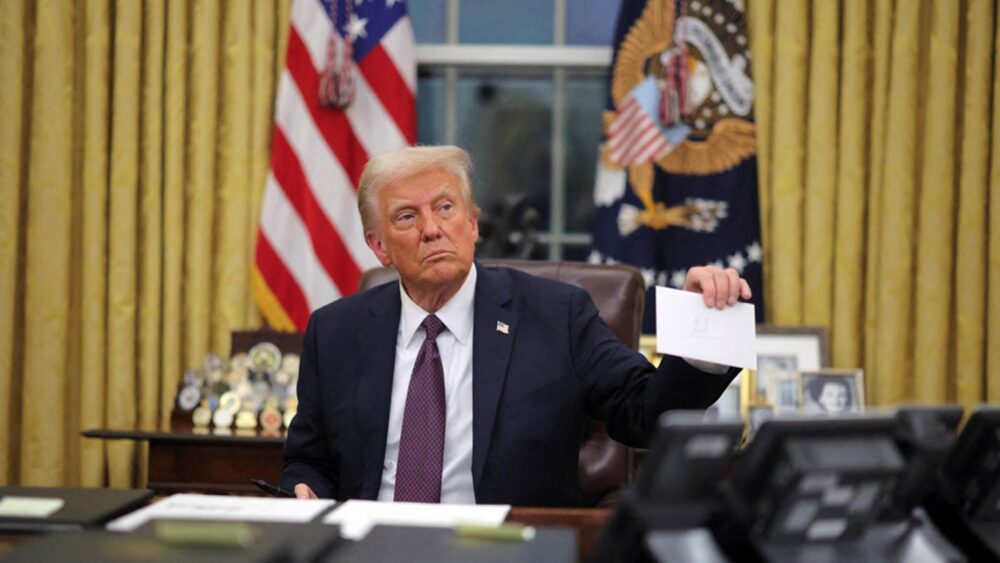
Just days after India’s Parliament cleared sweeping changes to the country’s nuclear liability framework, U.S. President Donald Trump has signed into law a defence statute that explicitly calls on Washington to work with New Delhi to align India’s nuclear liability rules with international standards.
The development has injected a fresh geopolitical dimension into India’s nuclear policy debate, drawing sharp reactions from the Opposition and raising questions about the timing and motivations behind the Centre’s legislative push.
On Friday, December 19, 2025, President Trump signed the National Defense Authorization Act (NDAA) for fiscal year 2026, a must-pass annual law that authorises U.S. defence spending from October 2025 to September 2026. Buried within the voluminous document is a provision advising the U.S. Secretary of State to engage the Indian government through the U.S.-India Strategic Security Dialogue to assess the implementation of the 2008 Indo-U.S. civil nuclear agreement and to “align (India’s) domestic nuclear liability rules with international norms.”
A Law Passed, A Signal Sent
The U.S. move comes barely two days after the Indian Parliament cleared the Sustainable Harnessing and Advancement of Nuclear Energy for Transforming India (SHANTI) Bill, a landmark piece of legislation that repeals the Atomic Energy Act, 1962 and the Civil Liability for Nuclear Damage (CLND) Act, 2010. The new law caps the liability of nuclear plant operators at ₹3,000 crore and opens the door to private participation in India’s nuclear sector, a space that had remained tightly controlled by the state for decades.
The SHANTI Act seeks to bring India closer to the Vienna Convention on Civil Liability for Nuclear Damage and align it with the Convention on Supplementary Compensation for Nuclear Damage (CSC) — precisely the convergence that the NDAA now encourages.
While India has featured in past NDAAs in the context of defence cooperation and Indo-Pacific security, analysts note that this is the first time in nearly a decade that the U.S. law has explicitly referenced India’s civil nuclear liability regime and the 2008 nuclear deal in such direct terms.
Opposition Sees External Pressure
The Opposition has seized on the NDAA language to attack the Centre, accusing it of rushing through a “vendor-friendly” law to appease foreign interests. Congress Rajya Sabha MP Jairam Ramesh said the U.S. statute revealed the real intent behind the government’s legislative urgency.
“Now we know for sure why the Prime Minister bulldozed the SHANTI Bill through Parliament earlier this week that, among other things, did away with key provisions of the CLND Act, 2010,” Ramesh wrote in a post on X. “It was to restore SHANTI with his once good friend.” He went on to dub the legislation the “TRUMP Act — The Reactor Use and Management Promise Act,” attaching an image of the NDAA clause referring to India.
The Congress and other Opposition parties had staged a walkout in the Lok Sabha, demanding that the SHANTI Bill be referred to a parliamentary standing committee for wider consultation, citing concerns over safety, accountability, and sovereignty.
Why Liability Matters
At the heart of the controversy lies the issue of supplier liability. The earlier CLND Act allowed nuclear plant operators to seek legal recourse from equipment suppliers if a defect contributed to a nuclear accident. That clause, introduced in the shadow of the 1984 Bhopal gas tragedy, was widely seen as a safeguard for Indian citizens but was also blamed for deterring foreign vendors — particularly U.S. and French firms — from entering India’s nuclear market.
By effectively removing statutory supplier liability and capping operator liability, the SHANTI Act significantly reduces legal exposure for private and foreign players. Supporters argue this is essential to unlock investment, modern technology, and long-delayed nuclear projects. Critics counter that it shifts risk away from corporations and onto the Indian public and exchequer.
Strategic and Commercial Stakes
India’s nuclear power ambitions are central to its long-term energy transition strategy, especially as it seeks to balance climate commitments with rising electricity demand. Foreign participation, long frozen due to liability concerns, could now revive stalled projects tied to the 2008 Indo-U.S. nuclear deal.
From Washington’s perspective, aligning India’s liability regime with global norms would remove a major obstacle for American companies looking to enter the Indian nuclear market, while also strengthening strategic ties with a key Indo-Pacific partner.
A Debate Far From Over
The convergence of the SHANTI Act’s passage and the NDAA’s signing has ensured that India’s nuclear policy will remain under intense scrutiny — both domestically and internationally. While the government maintains that the reforms are essential for growth, energy security, and global integration, critics warn that transparency, safety, and democratic oversight must not be casualties of geopolitical alignment.
As India navigates the complex intersection of sovereignty, safety, and strategic partnership, the question remains whether the new nuclear framework will deliver the promised investment without compromising public accountability.