








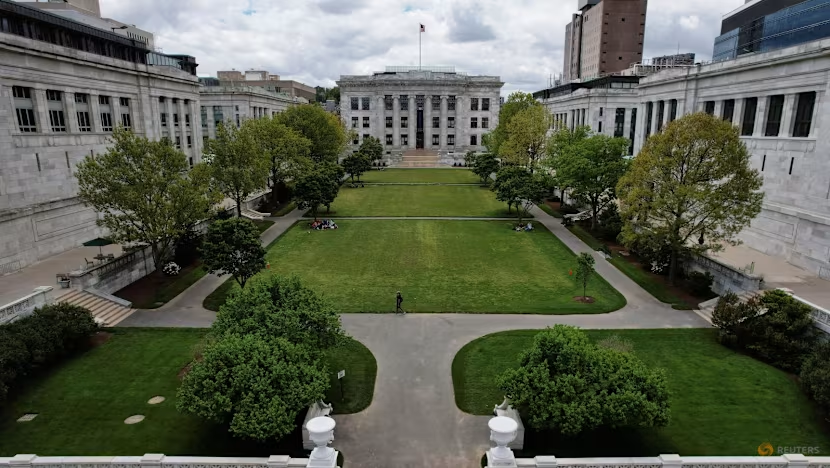
A former manager of the Harvard Medical School morgue has been sentenced to eight years in federal prison for orchestrating a years-long scheme involving the theft and sale of human body parts donated for medical research—an act prosecutors described as deeply disturbing and emotionally devastating for families who trusted the institution with their loved ones’ remains.
Cedric Lodge, 58, who oversaw the morgue for more than two decades, received the sentence on Tuesday from U.S. District Judge Matthew Brann in Williamsport, Pennsylvania. Lodge had been arrested in 2023 following a federal investigation that uncovered the illicit trafficking of human remains across state lines.
“The defendant caused deep emotional harm to an untold number of family members left to wonder about the mistreatment of their loved ones’ bodies,” federal prosecutors wrote in a sentencing memorandum submitted to the court.
A Betrayal of Trust
According to court records, Lodge exploited his position at one of the world’s most prestigious medical institutions to remove body parts from cadavers that had been voluntarily donated for scientific research and education. Prosecutors stated that Lodge transported heads, faces, brains, skin, and hands from the Harvard morgue to his residence in Goffstown, New Hampshire, where he stored and sold them to buyers across multiple states.
In May, Lodge pleaded guilty to transporting stolen goods across state lines, a federal offense carrying a maximum sentence of 10 years. Prosecutors urged the court to impose the full penalty, arguing that the crime “shocks the conscience” and was motivated not by necessity, but by profit and participation in what they described as the disturbing “oddities” market.
“This was not a momentary lapse in judgment,” prosecutors wrote. “It was a sustained, calculated exploitation of human remains for personal gain.”
Family Members Left Devastated
The emotional toll of the case has been profound. Families who donated the bodies of loved ones—often motivated by altruism and a desire to contribute to medical advancement—were left grappling with the realization that those remains had been desecrated.
Legal experts say the case highlights a significant breach of ethical safeguards in academic institutions. “This strikes at the heart of trust between the public and medical research institutions,” said a bioethics scholar familiar with the case. “Body donation is built on dignity and consent. Violations of that trust have long-lasting consequences.”
Wife Also Sentenced
Lodge’s wife, Denise Lodge, was also implicated in the scheme. Prosecutors said she assisted in facilitating the sale of stolen body parts to buyers, including two individuals in Pennsylvania who then resold the remains to others.
She was sentenced to one year in prison for her role in the operation.
Defense Seeks Leniency
During sentencing, Lodge’s attorney, Patrick Casey, requested leniency, acknowledging the seriousness of the crimes while emphasizing Lodge’s acceptance of responsibility.
“There is no dispute about the harm his actions have inflicted on both the deceased persons whose bodies he callously degraded and their grieving families,” Casey told the court. However, he argued that an eight-year sentence would still represent severe punishment for a man with no prior criminal record.
Judge Brann ultimately imposed a sentence below the maximum sought by prosecutors but emphasized the gravity of the offense and its moral implications.
Harvard’s Response and Legal Fallout
Harvard Medical School has not issued a public comment following Lodge’s sentencing. However, in earlier statements, the institution condemned his actions in strong terms.
“What happened was abhorrent and inconsistent with the standards and values that Harvard, our anatomical donors, and their loved ones expect and deserve,” the medical school said previously.
The legal consequences for Harvard may not end there. In October, a U.S. court ruled that Harvard Medical School can be sued by family members of donors whose bodies were mishandled. In that decision, Chief Justice Scott L. Kafker described the affair as a “macabre scheme spanning several years.”
Legal analysts say the ruling could open the door to substantial civil liability and renewed scrutiny of oversight mechanisms in medical schools nationwide.
A Broader Ethical Reckoning
The case has reignited debate around regulation and accountability in anatomical donation programs. While such programs are critical to medical education and research, they often operate with limited public visibility.
“This case exposes gaps in oversight that institutions can no longer afford to ignore,” said a former federal prosecutor. “Safeguards must be strengthened to ensure that donated bodies are treated with the dignity donors were promised.”
Conclusion
The sentencing of Cedric Lodge marks a significant moment of accountability, but it also raises uncomfortable questions about institutional responsibility, ethical oversight, and the protection of donor trust. For affected families, the prison sentence may offer a measure of justice—but it cannot undo the emotional damage inflicted by years of betrayal.
As civil lawsuits move forward and institutions reassess internal controls, the case stands as a stark reminder that even the most respected academic establishments are not immune to abuse when trust goes unchecked.