






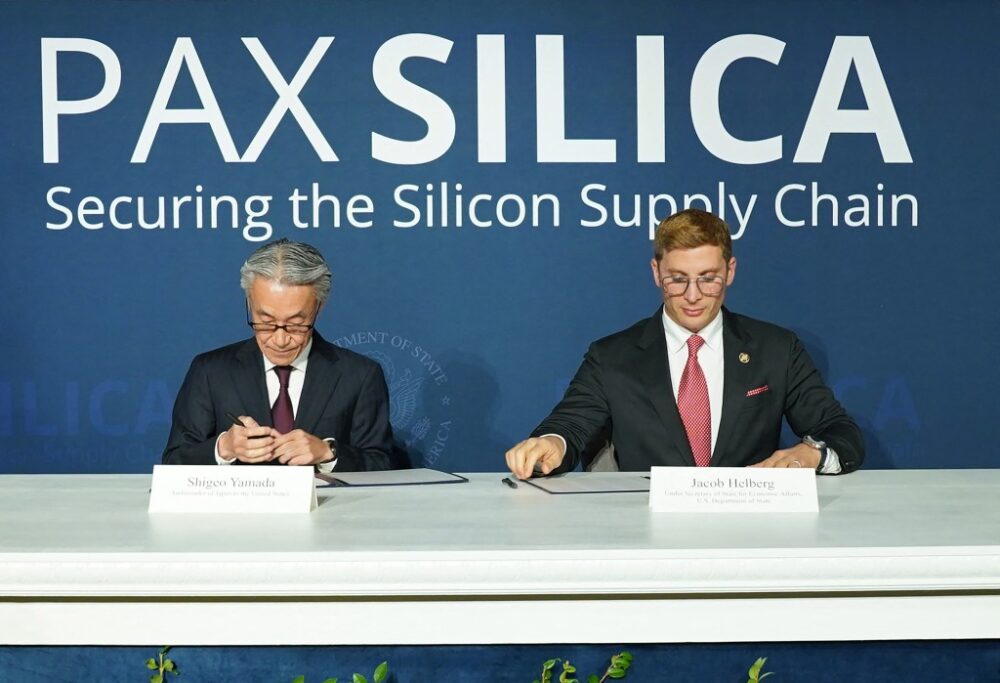
The United States has unveiled Pax Silica, a new strategic alliance aimed at safeguarding artificial intelligence and advanced technology supply chains, marking a decisive shift in global economic and geopolitical competition. Launched as a Department of State initiative, Pax Silica brings together eight technologically advanced nations at a time when the expanding BRICS bloc is reshaping global power equations.
The inaugural Pax Silica summit was convened in Washington on December 12, drawing senior officials and policymakers from Japan, the Republic of Korea, Singapore, the Netherlands, Israel, the United Arab Emirates, the United Kingdom, and Australia. Collectively, these countries represent some of the world’s most sophisticated AI ecosystems, semiconductor capabilities, and critical technology infrastructure.
A Strategic Answer to BRICS Expansion
The timing of the initiative is deliberate. BRICS, which added Indonesia as its 11th member in January 2025, now accounts for more than 41% of global GDP and nearly half the world’s population. Saudi Arabia’s formal accession in July 2025, along with more than 50 countries expressing interest in joining the bloc, has heightened concerns in Washington and allied capitals about shifting economic influence and technological dependencies.
Under Secretary of State for Economic Affairs Jacob Helberg, who convened the summit, framed the initiative in stark terms. “Economic security is national security — and together, we’re strengthening supply chains from minerals to semiconductors to computers and networks,” he said, signaling that Pax Silica is as much about geopolitics as it is about technology.
From Chips to Compute: What Pax Silica Aims to Do
Unlike traditional alliances focused on trade or defense, Pax Silica is designed as an economic security coalition for the AI age. Officials describe it as a framework to reduce reliance on single-country suppliers and to eliminate “coercive dependencies” across the entire technology stack — from critical minerals and semiconductor fabrication to cloud computing, logistics, and energy infrastructure.
Participating nations are home to global technology leaders such as Samsung, SK Hynix, ASML, Sony, Hitachi, DeepMind, Temasek, MGX, and Rio Tinto, giving the alliance deep industrial reach. According to Helberg, “It’s an industrial policy for an economic security coalition, and it’s a game changer because there is no grouping today where we can get together to talk about the AI economy and how we compete with China in AI.”
A Broader Geopolitical Vision
The alliance is also being positioned as a counterweight to China’s Belt and Road Initiative (BRI). Helberg was explicit about this strategic intent, stating, “By aligning our economic security approaches, we can start to have cohesion to basically block China’s Belt and Road Initiative, which is really designed to magnify its export-led model.” He added that Pax Silica could prevent strategic assets such as ports, highways, and logistics corridors from falling under undue foreign influence.
Deputy Secretary of State Christopher Landau sought to balance the narrative, stressing that Pax Silica is not about isolationism. “Our goal is not to close ourselves off from the rest of the world, but to build and deploy supply chains and information networks free from undue influence or control by countries or entities of concern,” he said.
From Dialogue to Action
Summit participants committed to moving beyond high-level discussions toward joint projects addressing vulnerabilities in semiconductor design, advanced manufacturing, logistics resilience, and energy generation. U.S. diplomats have been directed to operationalize these commitments by identifying infrastructure projects and coordinating economic security practices across overseas missions.
Officials involved in the initiative describe Pax Silica as an attempt to build trusted technology ecosystems, ensuring sensitive AI-related technologies are protected while remaining scalable and globally competitive.
A G7 Moment for the AI Era?
Helberg drew a historical parallel that underscores Washington’s ambitions for the initiative. “This grouping of countries will be to the AI age what the G7 was to the industrial age,” he said. If successful, Pax Silica could redefine how democratic, technology-driven economies collaborate in an era where AI, data, and compute power are central to national strength.
As global competition intensifies, Pax Silica signals that the battle for technological leadership is no longer just about innovation, but about who controls the supply chains that make innovation possible. In that sense, the alliance represents a clear message: the US and its partners intend to shape the rules — and the infrastructure — of the AI-driven global economy.