








Scientists have uncovered a mysterious “ghost” hiding inside one of the world’s most iconic scientific machines — CERN’s Super Proton Synchrotron (SPS). As the SPS approaches its 50th anniversary in 2026, researchers have finally mapped a long-suspected resonant disturbance that influences how particles travel inside the massive accelerator.
The finding, published in Nature Physics by teams from CERN and Goethe University Frankfurt, reveals that the ghost is actually a shifting 3D resonant structure that evolves over time — meaning its true behavior can only be understood using a 4D mathematical model.
Interestingly, the same physics behind this phenomenon is responsible for something as simple as spilling coffee while walking, or as dramatic as catapulting someone off a trampoline.
A 4-Mile Giant with a Hidden Flaw
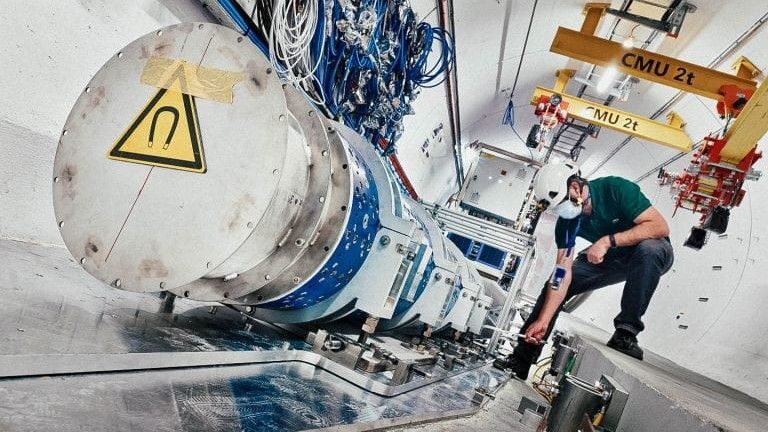
The Super Proton Synchrotron, built in the 1970s and spanning nearly four miles, remains central to CERN’s particle acceleration chain even today. It feeds powerful proton beams into the Large Hadron Collider (LHC) and received a major upgrade in 2019 with a high-capacity beam dump system.
So when physicists saw signs of unexpected resonant distortions — the so-called “ghost in the machine” — they knew they had to understand it fully to protect future experiments.
What Actually Is This ‘Ghost’?
The ghost isn’t supernatural — it’s resonance.
Whenever energy moves in waves, those waves can reinforce each other in specific locations, forming small zones where motion becomes amplified. This is the same principle behind:
- Your coffee sloshing higher and higher as you walk
- A trampoline jump launching someone unexpectedly high
- And inside SPS, particles losing stability and leaking from the beam
These amplified regions, if left unmanaged, cause beam degradation, which means valuable particles — and therefore energy — are lost.
Why Resonance Is So Dangerous for Particle Beams
Inside a particle accelerator, even tiny vibrations matter. Every component, joint, and electromagnetic interaction contributes its own oscillations.
As the system becomes more complex, these vibrations overlap, multiply, and create nonlinear resonances.
Researchers explain it simply:
The more energetic the proton beam becomes, the more sensitive it is to these harmonic distortions.
This is a critical challenge not only for CERN, but also for any facility trying to control high-energy plasma — including nuclear fusion reactors such as tokamaks. Resonant disturbances can create energy “dead zones” where heat dissipates, undermining performance.
The Breakthrough
By plotting the resonant distortions in multiple dimensions over time, scientists were able to isolate and model the ghost with high precision. This new 4D representation helps them predict when and where particle losses may occur, improving beam efficiency and stability.
As the SPS prepares for its next decade of upgrades and experiments, understanding this hidden resonance ensures cleaner, stronger, and more reliable proton beams — strengthening research at the heart of modern physics.