







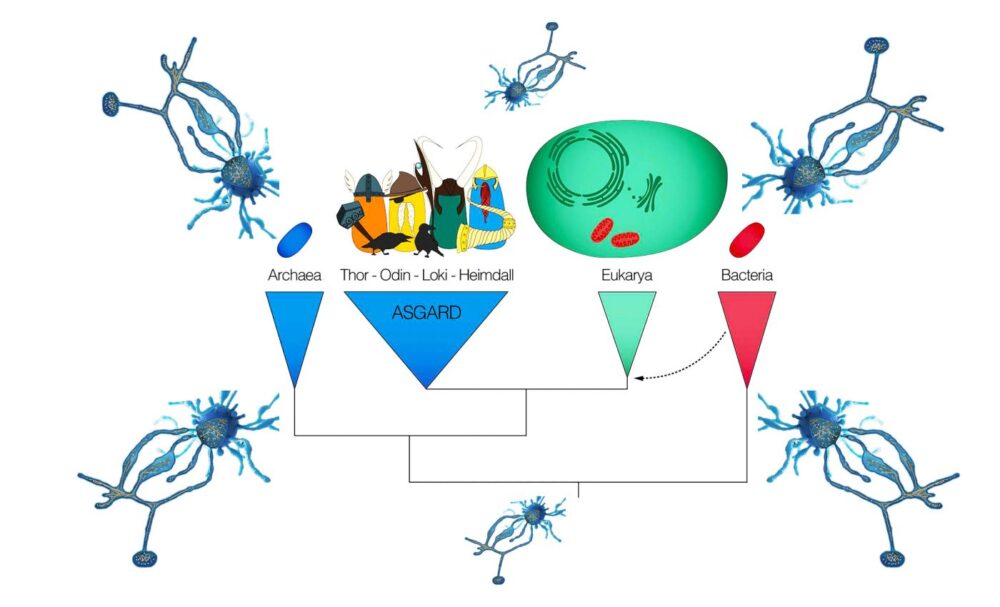
All humans — and every plant, animal, fungus, and complex organism on Earth — are built from eukaryotic cells, which contain a nucleus and sophisticated internal structures. In contrast, bacteria and archaea have far simpler cellular designs.
For decades, biology textbooks described life as a three-domain system:
- Bacteria
- Archaea
- Eukaryotes
But new genomic studies are reshaping that picture. Increasingly, scientists support a two-domain model, placing eukaryotes within the archaeal branch — and linking us to a mysterious microbial group known as Asgard archaea.
Asgard Archaea: The Microbes That May Be Our Earliest Ancestors
Among archaea, one cluster stands out for its unusual and complex genomes — the Asgard archaea, named after the realm of Norse gods. Earlier studies hinted that these microbes sit right beside the lineage that eventually evolved into all complex life.
This raised major evolutionary questions:
- Which Asgard lineage is closest to humans?
- How did its genome evolve?
- What kind of environment did this ancestor inhabit?
According to Brett Baker of the University of Texas at Austin, identifying this ancestor is a significant step toward understanding how simple microbes transformed into complex eukaryotic cells.
A Difficult Hunt for Life’s Deepest Roots
Because Asgard archaea are nearly impossible to grow in lab cultures, researchers searched for them in extreme environments: deep-sea vents, hot springs, and ocean sediments from 11 global sites.
They extracted DNA directly from these samples and reconstructed it into metagenome-assembled genomes (MAGs) — essentially piecing together the genetic identities of microbes that have never been seen alive.
The search produced 63 new Asgard genomes, dramatically expanding what scientists know about this microbial family. Within the Heimdallarchaeia subgroup, they uncovered surprising genome diversity, including a new order called Hodarchaeales, which contains some of the largest Asgard genomes discovered so far.
Building the Family Tree of Life
To determine how these microbes are related to humans, scientists analyzed proteins shared across archaea and eukaryotes. After comparing hundreds of genomes, a clear pattern emerged:
Eukaryotes form a “well-nested clade” within Asgard archaea.
This means that rather than branching separately, complex cells evolved from within the Asgard group.
The closest microbial relatives to humans appear to be within Hodarchaeales, part of the Heimdallarchaeia lineage — positioning them as the nearest known ancestors of all eukaryotic life.
Reconstructing Ancient Microbial Lifestyles
Researchers next examined gene families to reconstruct what ancestral Asgard genomes might have looked like.
Key findings include:
1. Asgard ancestors experienced major gene duplication events
This expansion created larger genomes and more proteins than typical archaea — a trait associated with increasing cellular complexity.
2. The earliest Asgards likely used the Wood–Ljungdahl pathway
This metabolic system allows cells to use inorganic carbon to build organic molecules, suggesting these early microbes were chemolithotrophs thriving in extremely hot environments such as hydrothermal vents.
3. A shift toward more “modern” metabolic systems
As the lineage moved closer to the ancestor of eukaryotes, it:
- Abandoned the Wood–Ljungdahl pathway
- Switched to heterotrophic metabolism (feeding on organic matter)
- Developed metabolic pathways resembling those in human cells today
This includes glycolysis (the Embden–Meyerhof–Parnas pathway) and a partial oxidative pentose phosphate pathway.
The Ancestor Closest to Us
The common ancestor shared by Hodarchaeales and eukaryotes likely:
- Lived at moderate temperatures
- Used a full electron transport chain
- Performed anaerobic respiration using nitrate rather than oxygen
This suggests our cellular “grandparent” inhabited oxygen-poor but chemically rich environments and produced energy in ways that bridge microbial and eukaryotic worlds.
“This is the first time we’re seeing the molecular blueprint of the ancestor that led to all eukaryotic cells,” said researcher Valerie De Anda.
Emerging Complexity in Asgard Microbes
Recent imaging shows that some Asgard archaea contain actin-based internal structures, reminiscent of the cytoskeleton found in eukaryotic cells. These features imply that the building blocks of complexity were already evolving before true eukaryotes emerged.
Scientists also found that Asgard archaea possess many genes once thought to exist only in eukaryotes — raising important questions about how these genes function in simpler organisms.
According to Baker, studying Asgard archaea may reveal how the first complex cells assembled their internal architecture, divided tasks, and evolved into the diverse life forms seen today.
Why Asgard Archaea Matter
Research into Asgard archaea provides vital clues about:
- How simple microbes evolved cellular complexity
- How gene duplications fueled innovation
- What metabolic tools existed before eukaryotes appeared
- How Earth’s earliest environments shaped evolution
Ultimately, these microbes help scientists trace the origins of humanity and show how life’s most sophisticated systems began within what once appeared to be “just another microbe.”