







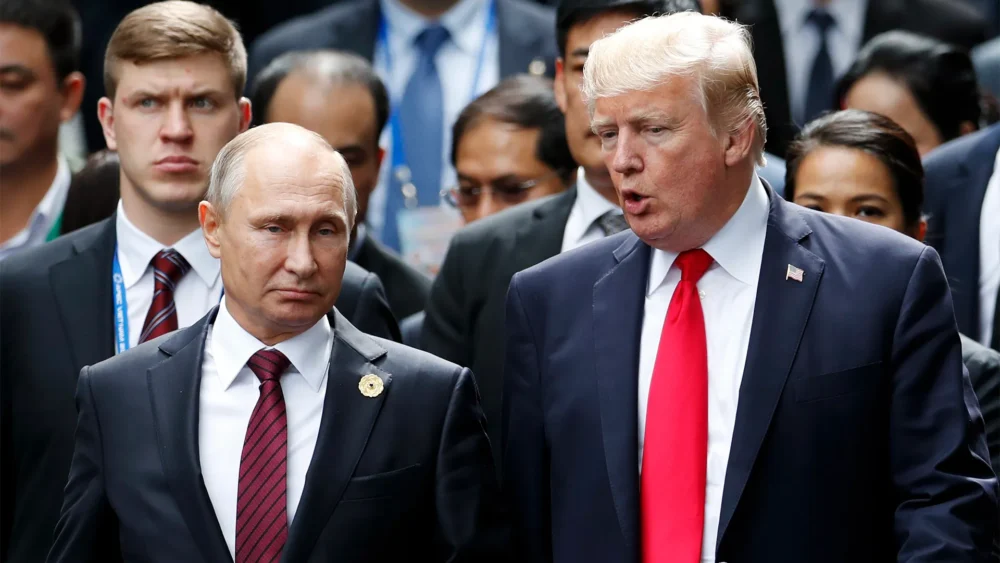
Vladimir Putin appears in no hurry to accept any peace deal, and the very fact that Washington is seeking his cooperation seems to strengthen his resolve. A five-hour meeting between envoys of U.S. President Donald Trump and the Kremlin leadership ended with little publicly to show. To understand why, one must examine the conflict through Moscow’s strategic lens.
This is a war that Putin initiated with the expectation of a rapid and decisive victory, aimed at restoring Russia’s image as Europe’s dominant military force. The plan rested on the belief that Ukraine would collapse within days, especially following the United States’ chaotic withdrawal from Afghanistan. Instead, the conflict hardened into a brutal war of attrition. For a time, Russia even faced the prospect of strategic failure, as Western support helped Ukraine achieve battlefield successes that once seemed impossible.
The global landscape shifted again with Trump’s return to the White House and his visible eagerness to end the war quickly. For Putin, this change in tone signaled opportunity. With no election pressures and no clear successor, his only true limit remains time itself. When Trump publicly frames the Ukraine war as “not his fight” and stresses the cost of continued involvement, Putin likely hears not restraint—but hesitation from the world’s most powerful military.
This moment represents a historic reversal that few in Moscow could have imagined: the United States urging Russia to negotiate peace. And from Putin’s perspective, prolonging that process only improves Russia’s leverage.
Following recent talks, Putin’s aide, Yuri Ushakov, referenced a 27-point proposal along with several supplementary documents. These announcements appeared crafted to unsettle Ukrainian President Volodymyr Zelensky, whose team had earlier spoken of a separate 20-point framework. Yet real diplomacy is now unfolding largely behind closed doors, offering Kyiv little immediate reason for optimism.
Trump’s earlier Thanksgiving deadline for a rapid agreement has quietly faded. Ukraine now faces months of uncertainty, intensified by the unpredictable nature of Trump’s public messaging—swinging between the threat of tougher sanctions and talk of advanced weapons, then abruptly echoing Russian narratives or placing pressure on European allies.
The psychological toll on Ukraine has been immense. When historians look back, they may focus not only on Ukraine’s extraordinary resistance against a far larger aggressor, but also on how that sacrifice was undercut by erratic great-power diplomacy and shifting political priorities in Washington.
Trump is right to want the war to end swiftly. However, that goal is built on a dangerous misreading of Putin. The Russian leader is adaptable and tactical, but driven by a broader ambition: to reshape the global security order and challenge decades of U.S. dominance.
Putin is not invincible. The failed Wagner rebellion in 2023 exposed cracks within his power structure, and Russia faces growing manpower and budgetary strain. Yet unlike Western leaders, he operates without electoral checks, legal investigations, or looming political rivals. His economy and industry have been fully reoriented toward war. In many ways, continued conflict now serves as the backbone of his political survival.
So where does that leave Trump’s peace initiative? Ushakov suggested that parts of the proposed deal were acceptable while others were sharply rejected. Reports hint that Kyiv may have privately explored limited territorial compromises—once a red line of the war—but nothing has been confirmed publicly. Any suggestion of concessions remains tightly controlled to avoid weakening Ukraine’s future bargaining position. Regardless of the incentives attached, Moscow declined to take the offer.
The pattern for the months ahead is becoming clearer. Militarily, Russia is advancing slowly but steadily. Ukraine, by contrast, is strained by troop shortages, funding challenges, power disruptions, and growing domestic pressures. With diminishing external support and rising casualties, public morale is under severe stress.
Trump’s negotiating instincts favor pressuring allies into quick compromises—an approach that may work in business deals but is ill-suited to this conflict. He is not negotiating over real estate with a reluctant seller; he is attempting to persuade an armed occupier to withdraw from territory seized through force. The incentives and risks are fundamentally different.
For Putin, the prolonged fight itself is part of the reward. He is watching with visible satisfaction as Washington—once Ukraine’s strongest backer—now seeks his approval for peace through intermediaries. While Russia’s battlefield progress comes at a heavy human cost, the broader geopolitical drama increasingly resembles a scenario long imagined in Moscow: a weakened West appealing for compromise.