




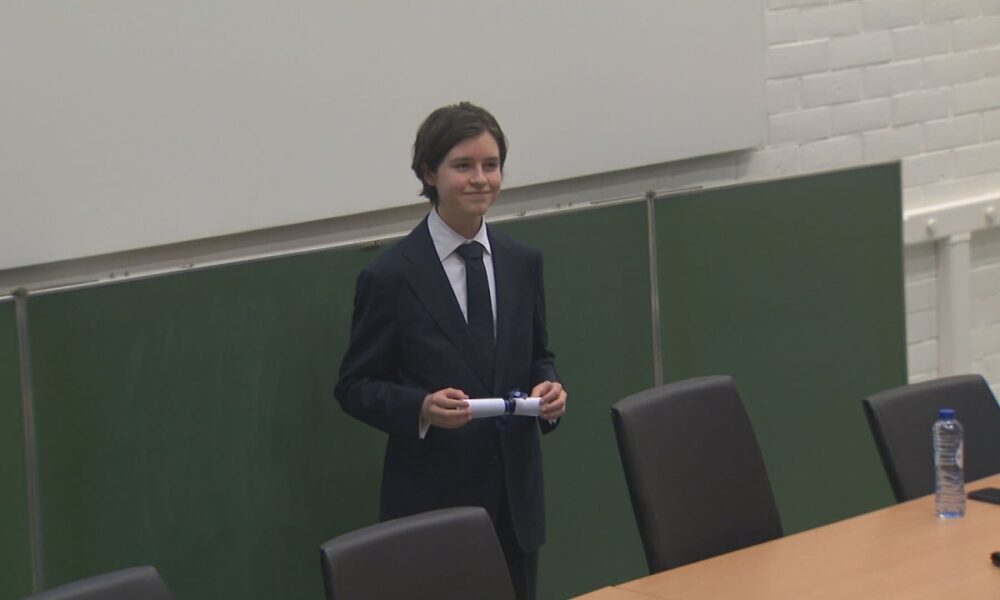
A 15-year-old prodigy has stunned the global scientific community by completing a doctorate in one of the most complex fields known to science — quantum physics. Laurent Simons, often called Belgium’s “Little Einstein,” has achieved what most researchers only dream of after decades of study.
Laurent’s academic journey has moved at an extraordinary pace. He entered primary school at just four years old and completed it by the time he turned six. By twelve, he had already earned a master’s degree in quantum physics, diving deep into subjects such as bosons, black holes, and the mathematical frameworks that describe the universe at its smallest scales.
This week, he successfully defended his doctoral thesis at the University of Antwerp, officially becoming one of the youngest individuals in modern history to earn a PhD in physics. His doctoral work focused on advanced quantum phenomena, including Bose polarons in superfluids and supersolids — topics typically explored by researchers in their late twenties or beyond.
Behind this remarkable intellectual pursuit lies a deeply personal motivation. After losing his grandparents at the age of eleven, Laurent developed a powerful desire to understand aging and human longevity, not for fame or profit, but to help extend healthy life for others.
Scientists and psychologists alike continue to be amazed by his exceptional cognitive abilities. With an IQ measured at 145 — a level reached by only a fraction of one percent of the population — Laurent possesses a photographic memory that allows him to absorb and apply complex concepts with striking ease. Global technology firms from the United States and China have reportedly offered him lucrative opportunities, but his parents have declined, choosing instead to protect his independence and well-being.
Although Laurent is not officially the youngest PhD holder in history — that honor belongs to Karl Witte, who earned his doctorate at thirteen in 1814 — his achievement remains almost unparalleled in the modern era of advanced physics.
Now, at just fifteen, Laurent is preparing for another bold leap. He plans to shift his focus from quantum theory to medical artificial intelligence, with the goal of earning a second doctorate. His long-term ambition is to apply physics and AI together to unlock the biological mechanisms of aging and push the boundaries of human health.
Whether as a quantum pioneer or a future innovator in medical science, Laurent Simons stands at the threshold of a journey that could reshape multiple fields. For him, the pursuit of knowledge is only just beginning.