





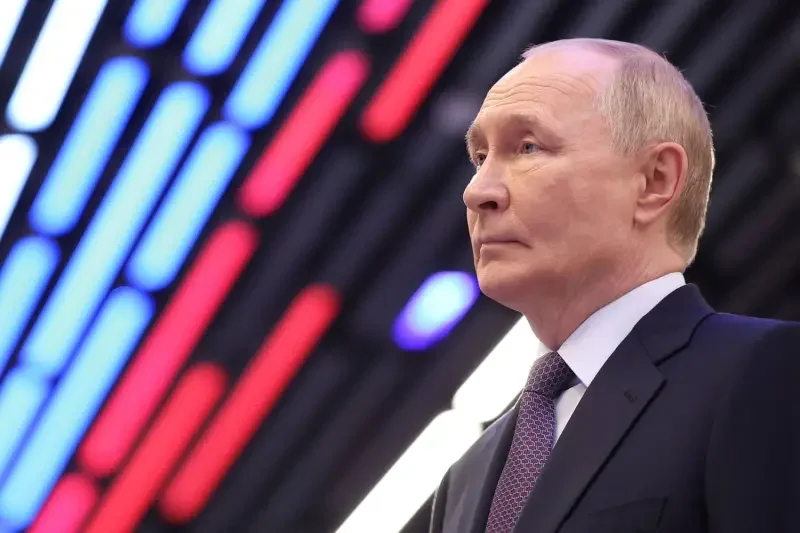
Russian President Vladimir Putin has reiterated his long-standing conditions for ending the war in Ukraine, insisting that Moscow will only halt military operations if Ukrainian forces fully withdraw from territories claimed by Russia.
For years, Putin has demanded legal recognition of areas seized by Moscow, including Crimea, which was annexed in 2014, and large portions of the eastern Donbas region. Ukraine has firmly rejected surrendering any remaining territory it controls in Donbas, calling such a move unacceptable and equivalent to rewarding aggression.
Responding to Putin’s remarks, Ukrainian President Volodymyr Zelensky stated that Russia continues to show disregard for genuine efforts to bring the war to an end.
During a visit to Kyrgyzstan, Putin accused Kyiv of being prepared to fight “to the last Ukrainian,” adding that Russia was also ready to persist if necessary. He claimed that Russian forces currently hold the advantage on the battlefield and warned that if Ukraine does not pull back from Donbas — which includes the Luhansk and Donetsk regions — Moscow would continue advancing by military force.
Despite these claims, Russia’s progress in eastern Ukraine has been slow and costly. According to the Washington-based Institute for the Study of War, at the current pace it could take nearly two more years for Russia to capture the remainder of the Donetsk region.
Putin’s statements followed a week of heightened diplomatic activity involving behind-the-scenes talks between the United States and Ukraine on a proposed peace framework reportedly drafted earlier by American and Russian officials. That initial plan, believed to have favored Moscow’s demands, was later revised during negotiations in Geneva involving Ukrainian, US, and European representatives.
However, the most contentious issues — territorial control and long-term security guarantees for Ukraine — remain unresolved. Putin confirmed that Russia has now reviewed the revised draft and said it could serve as a potential “foundation” for a future peace agreement, though he emphasized that key points still require further diplomatic clarification.
When questioned about the possibility of Crimea and Donbas being acknowledged as Russian-controlled in practice but not legally, Putin said those matters were part of discussions with US officials.
A US delegation led by special envoy Steve Witkoff is expected to arrive in Moscow next week. US President Donald Trump indicated that his son-in-law Jared Kushner may also take part in the visit.
Meanwhile, Zelensky confirmed that Ukrainian and American representatives would continue talks to turn the Geneva discussions into concrete steps toward peace and firm security guarantees. He did not name the participants, but his chief of staff, Andriy Yermak, earlier announced that US Army Secretary Dan Driscoll was scheduled to visit Kyiv.
Trump previously remarked that only a few major disagreements remain between Russia and Ukraine, signaling that a high-level meeting between the two leaders would depend on progress toward a finalized agreement.
Putin also renewed his criticism of Ukraine’s leadership, again questioning its legitimacy and stating that any agreements signed with the current government would be meaningless. Ukraine, however, has remained under martial law since the full-scale invasion began in February 2022, making elections legally impossible. Earlier this year, Ukraine’s parliament unanimously affirmed Zelensky’s authority.
Additionally, Putin brushed aside warnings from European leaders that Russia could pose a future threat to the wider continent, calling such concerns exaggerated.
While the White House and President Trump have expressed optimism over recent diplomatic momentum, European leaders continue to voice serious doubts about whether Moscow is genuinely committed to ending the war.